






BY: Sonia Bansal, Editor at NewsPatrolling.com
India, the world’s largest democracy, is built on the principle that every citizen deserves equal representation in the country’s legislative institutions. As populations shift over time due to migration, urbanization, and demographic changes, maintaining this balance becomes increasingly challenging. This is where the concept of delimitation comes into play. Although often referred to as the “Delimitation Bill,” it broadly represents the legal and constitutional framework that enables the redrawing of electoral constituency boundaries to ensure fair and equitable representation.
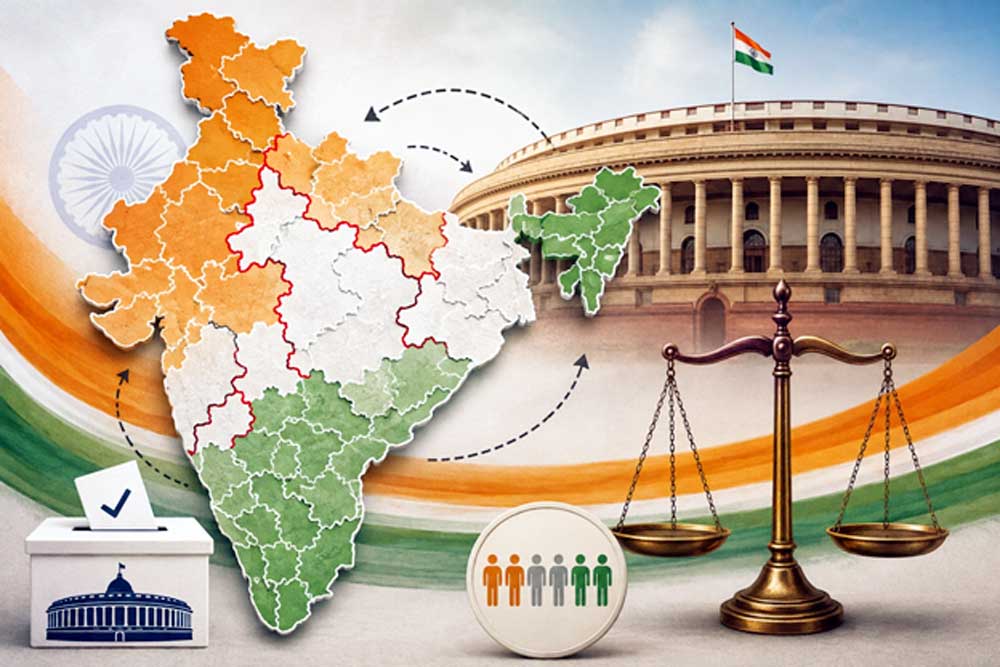
Delimitation is the process of redefining the boundaries of parliamentary and state assembly constituencies based on population data from the latest Census. Its primary objective is to ensure that each elected representative speaks for a roughly equal number of citizens, thereby upholding the democratic principle of “one person, one vote.”
Understanding Delimitation
In India, delimitation is carried out by the Delimitation Commission, an independent statutory body appointed by the Central Government. The Commission typically includes a retired Supreme Court judge as its chairperson, the Chief Election Commissioner, and the respective State Election Commissioners. Once the Commission finalizes its recommendations, they have the force of law and cannot ordinarily be challenged in court.
The process involves:
- Redrawing the boundaries of Lok Sabha and State Legislative Assembly constituencies.
- Allocating reserved constituencies for Scheduled Castes (SCs) and Scheduled Tribes (STs) based on their population.
- Ensuring that constituencies have, as far as possible, equal populations while considering geographical features, administrative boundaries, and communication facilities.
Constitutional Provisions
The Constitution of India provides the legal foundation for delimitation through Articles 82 and 170. After every Census, Parliament is empowered to enact legislation to facilitate the readjustment of constituencies. The Delimitation Acts passed by Parliament authorize the establishment of the Delimitation Commission.
However, the allocation of Lok Sabha seats among states has been frozen for several decades. Initially frozen in 1976 to encourage states to adopt effective family planning measures without fearing a reduction in political representation, this freeze was later extended through the 84th Constitutional Amendment until the first Census conducted after 2026. While constituency boundaries were revised based on the 2001 Census, the total number of seats allocated to each state remained unchanged.
Why Is Delimitation Important?
Population growth in India has not been uniform across states. Southern and several western states have generally experienced slower population growth due to successful implementation of education and family welfare measures. On the other hand, several northern and central states have witnessed relatively higher population growth.
As a result, many constituencies today represent vastly different population sizes. Some Members of Parliament represent over three million people, while others represent significantly fewer. Delimitation seeks to address such imbalances and make representation more equitable.
A fresh delimitation exercise could also improve governance by:
- Making representation more balanced.
- Reflecting urban expansion and migration.
- Ensuring newly developed regions receive adequate political representation.
- Strengthening the democratic legitimacy of elections.
Key Concerns and Challenges
Despite its democratic objectives, delimitation remains a politically sensitive issue.
One of the biggest concerns is the potential redistribution of parliamentary seats among states. States that have successfully controlled population growth worry that they may lose relative political influence if seat allocation is based solely on population. Conversely, states with higher population growth argue that greater populations deserve proportionately greater representation.
Another challenge involves balancing numerical equality with geographical realities. Remote, mountainous, tribal, and sparsely populated regions often require special consideration to ensure effective representation despite having smaller populations.
Political parties also closely watch the delimitation process because changes in constituency boundaries may significantly alter electoral prospects. While the Delimitation Commission functions independently, political debates surrounding its outcomes are almost inevitable.
Potential Impact on Indian Politics
The next nationwide delimitation exercise is expected to have far-reaching consequences for India’s political landscape. It could alter the balance of representation in the Lok Sabha, influence coalition politics, reshape electoral strategies, and affect the distribution of political power among states.
Urban areas experiencing rapid population growth may receive greater representation, while rural constituencies could undergo substantial boundary adjustments. Political parties will need to adapt to changing voter demographics and newly constituted constituencies.
The exercise may also renew discussions on increasing the total strength of the Lok Sabha so that representation improves without significantly reducing any state’s relative influence. Such proposals aim to balance demographic fairness with federal harmony.
The Way Forward
Delimitation is an essential democratic exercise that ensures electoral representation remains aligned with changing population realities. However, given India’s vast diversity and federal structure, the process must be conducted with transparency, impartiality, and sensitivity toward regional concerns.
Any future legislation or policy related to delimitation should strive to balance the constitutional principle of equal representation with the legitimate concerns of states that have invested heavily in population stabilization and socio-economic development. Broad political consensus, public awareness, and institutional independence will be critical to maintaining confidence in the process.
Conclusion
Delimitation is more than a technical redrawing of electoral boundaries—it is a cornerstone of representative democracy. As India prepares for its next phase of electoral reforms following the post-2026 Census, the debate surrounding delimitation will continue to shape the country’s political future. If implemented fairly and transparently, the delimitation process can strengthen democratic institutions, improve representation, and ensure that every citizen’s vote carries equal value in the world’s largest democracy.